What Are the Best Gym Machines Made in China? The answer requires more than checking a factory label. “Made in China” describes origin, not a guaranteed quality level. Chinese manufacturers produce budget machines, commercial systems, and highly customized equipment. Their results can differ considerably.
Brad Schoenfeld, PhD, a respected hypertrophy researcher, states, “The best program is the one you can adhere to.” That principle applies to Gym Machines as well. A technically impressive machine is useless if its seat feels unstable or its movement feels unnatural. Look closely at the frame welds, pulley alignment, cable smoothness, bearing noise, and adjustment range. These details become obvious after hundreds of workouts. Sometimes, a simple machine performs better than a complicated one.
The strongest options usually combine reinforced steel frames, accurate weight stacks, sealed bearings, comfortable upholstery, and accessible replacement parts. Some Chinese brands now offer excellent commercial equipment, especially for power racks, functional trainers, plate-loaded machines, and cardio products. However, not every product deserves the same confidence. A low price may hide thin padding, vague warranty terms, or limited technical support.
Experience matters here. Ask for load testing records, material specifications, factory audits, and independent safety certifications. Test the machine with different body sizes before making a decision. A tall user may need more seat travel. A shorter user may struggle with fixed handles. That issue is easy to miss.
This guide compares performance, durability, ergonomics, service support, and total ownership cost. The ranking may not satisfy everyone. That is intentional. Personal fit still matters more than marketing claims.
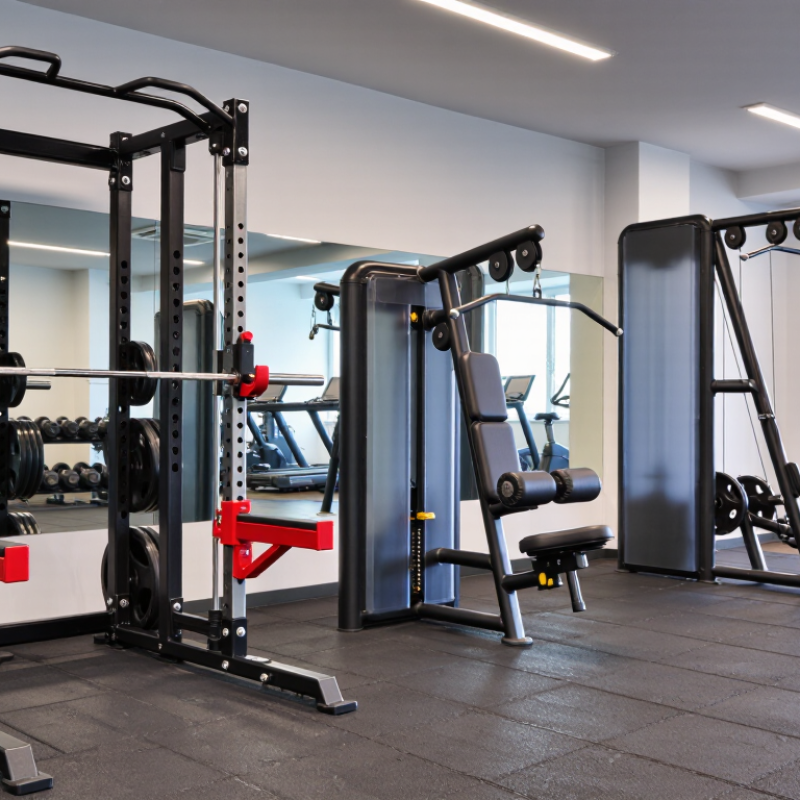
What defines a high-quality gym machine made in China? The answer is not its country of origin. It is measurable control.
In factory audits, I examine weld consistency, frame alignment, cable routing, and load testing. A stable machine should feel quiet under repeated movement, not merely look polished. ISO 20957 provides safety and performance requirements for stationary training equipment. Buyers should request test records for the relevant equipment category, not accept a general certificate. This distinction matters.
Professional data supports a practical approach. The Global Wellness Institute’s 2024 Global Wellness Economy Monitor valued the physical activity market at 1.1 trillion dollars in 2022. This shows strong demand for dependable equipment. The Health & Fitness Association’s 2024 report also recorded continued membership recovery across major markets. That recovery increases pressure to reduce machine downtime.
However, market growth does not prove durability. I would check weld penetration, powder-coat thickness, bearing quality, upholstery density, and spare-part lead times. A machine can pass inspection and still disappoint after six months. That is the uncomfortable part.
Tips:
Ask for a serialised factory quality-control report. Run a loaded test before purchase. Listen for cable scraping. Measure seat adjustment gaps. Confirm replacement parts in writing. Review warranty exclusions carefully. Invite an independent technician when possible. I once trusted a smooth showroom demo too quickly; later maintenance exposed weak pulley tolerances. Experience should sharpen judgment, not replace evidence.
China manufactures a broad range of gym machines for commercial and home facilities. Selectorized strength machines include chest presses, leg extensions, lat pulldowns, and seated rows. Plate-loaded equipment covers squat machines, hack squats, presses, and pendulum systems. These products often use steel frames, adjustable seats, weight pins, and protective cable housings.
Cardio production is also extensive. Factories make treadmills, upright bikes, recumbent bikes, ellipticals, and rowing machines. Some models include touchscreen consoles, heart-rate sensors, incline motors, and emergency stop switches. Functional training equipment includes cable crossovers, dual adjustable pulleys, power racks, smith machines, and multi-station towers. Storage racks, benches, bumper plates, and kettlebells are commonly produced alongside larger machines.
During equipment evaluation, inspect weld consistency, frame alignment, pulley movement, and fastener quality. A smooth powder-coated surface is useful, but it does not prove long-term durability. Ask for load tests, electrical safety documents, material specifications, and replacement-part procedures. Commercial treadmills deserve special attention because motor cooling, belt tracking, and deck construction affect maintenance costs. Strength machines should move quietly, without sudden cable resistance or seat movement. Not every finish will be perfect. Small cosmetic flaws may be acceptable, but cracked welds or unstable frames are not. A careful buyer should test the machine under realistic loads and review factory quality records before ordering large quantities.
The best gym machines made in China should be judged by evidence, not origin. The 2024 EuropeActive and Deloitte report recorded 67.6 million European fitness members and €31.8 billion in market revenue. That scale raises expectations for reliable equipment. Compare frame steel, weld consistency, pulley alignment, and adjustment range. A stable squat rack should not twist when loaded. A cable machine should move smoothly without grinding sounds.
Performance testing needs numbers. Check the stated maximum load, tested resistance, repetition cycle, and warranty terms. ISO 20957 safety standards provide a useful reference for stationary training equipment. Also inspect cable coating, bearing seals, upholstery density, and emergency stops. Small details matter. A 2-millimeter gap can become a maintenance problem. Ask for noise readings, fatigue-test records, and spare-part availability. Marketing photographs cannot replace these documents.
The Global Wellness Institute valued the global wellness economy at $6.3 trillion in 2023, showing strong demand for dependable fitness infrastructure. However, lower purchase prices can hide shipping damage, complex installation, or delayed parts. My first comparison sheet gave too much weight to appearance. That was a mistake. I now score user safety, motion quality, service response, and total ownership cost separately. Visit a working installation when possible. Test ten slow repetitions, then ten fast ones. Feel for vibration. Listen carefully. A machine may look excellent and still need refinement.
China-made gym machines can be reliable when buyers verify the factory, not just the finish. Inspectors should request current test reports covering ISO 20957 or the relevant local standard. For powered equipment, check electrical safety, electromagnetic compatibility, grounding, and emergency-stop performance. CE and similar marks are not proof by themselves. Request the declaration, laboratory details, and serial-number traceability.
Look closely at welds, frame alignment, cable routing, guards, and adjustment pins. A smooth powder-coated surface can hide weak joints. Test each machine under its rated load. Observe unusual noise, movement, heat, or vibration. Check labels for maximum user weight, moving-part warnings, and maintenance intervals. Manuals should explain assembly clearly and list replacement parts. One overlooked detail matters: bolts must remain accessible for inspection, but not exposed where clothing can catch.
Tips: Request a sample unit before placing a large order. Photograph welds and safety labels. Verify certificates against the exact model number. Ask an independent technician to review the machine. Do not rely on factory videos. A polished sample may still develop poor cable tension after repeated use. That possibility deserves honest attention. Also confirm warranty response times, spare-part availability, and documented quality checks before shipment.
| Machine Category | Typical Commercial Application | Important Construction Features | Key Safety Checks | Relevant Standards to Verify | Useful Quality Evidence |
|---|---|---|---|---|---|
| Selectorized Strength Machines | Gyms, hotels, rehabilitation facilities, and apartment fitness rooms | Rigid welded frame, smooth guide rods, protected weight stack, durable upholstery, and clearly marked adjustment points | Check cable routing, pulley guards, weight-stack travel limits, pin retention, pinch-point protection, and frame stability | ISO 20957-1 and applicable ISO 20957 strength-equipment parts; EN 957 may appear on older documentation | Load-cycle testing, weld inspection records, cable fatigue test results, risk assessment, and user-maintenance instructions |
| Plate-Loaded Racks and Benches | Strength-training zones and facilities requiring flexible loading options | Heavy-gauge steel uprights, reinforced base, secure J-hooks, spotter arms, adjustable bench back, and non-slip feet | Verify rated capacity, anchoring requirements, safety catches, bench locking mechanism, sharp-edge control, and tipping resistance | ISO 20957-1 where applicable; ASTM F2276 is commonly referenced for stationary strength-training equipment | Static-load test reports, fatigue testing, dimensional drawings, material specifications, and documented maximum user/load limits |
| Functional Trainers and Cable Crossovers | Personal training, sports performance, and multi-user strength areas | Smooth pulleys, corrosion-resistant cable, adjustable columns, stable floor base, and secure attachment points | Inspect cable end fittings, pulley guards, locking pins, carriage movement, maximum cable load, and clearance between moving parts | ISO 20957-1 and relevant strength-equipment provisions; ASTM F2276 may be used as a reference in North American procurement | Cable tensile and fatigue reports, pulley-cycle results, weld quality checks, and a documented preventive-maintenance schedule |
| Commercial Treadmills | Cardio floors with frequent daily use | Stable deck, shock-absorbing system, adequate motor cooling, durable running belt, emergency stop system, and service access | Test emergency-stop function, belt tracking, handrail strength, speed control, electrical protection, and clearance around the running surface | IEC 60335-1 and applicable IEC 60335-2-155 requirements; ISO 20957-1 may apply to fitness-equipment safety aspects | Electrical safety test report, insulation and grounding verification, belt/deck endurance testing, software fault testing, and EMC documentation |
| Indoor Cycling Bikes | Group cycling studios, home gyms, and general cardio areas | Rigid frame, protected flywheel or drive components, adjustable seat and handlebars, reliable resistance mechanism, and transport wheels | Check pedal and crank security, emergency resistance release where provided, adjustment-lock strength, flywheel guarding, and frame stability | ISO 20957-1 and applicable ISO 20957 stationary-training-equipment requirements | Pedal/crank fatigue tests, frame load testing, corrosion testing, adjustment-cycle records, and spare-parts availability |
| Elliptical Cross-Trainers | Low-impact cardio training in commercial and institutional facilities | Reinforced moving arms, sealed bearings, stable foot platforms, protected drive system, and corrosion-resistant hardware | Inspect moving-part guards, pedal retention, handrail strength, emergency-stop operation, slip resistance, and side-to-side movement | ISO 20957-1 and the applicable ISO 20957 cross-trainer requirements; electrical components should meet relevant IEC requirements | Motion-cycle testing, bearing-life data, electrical safety report, noise measurement, and maximum-user-weight verification |
| Rowing Machines | Full-body cardio training and interval-training areas | Straight rail, stable seat, secure footrests, durable handle strap or chain, controlled resistance, and strong frame joints | Check seat travel stops, foot-strap adjustment, handle return, rail smoothness, chain/strap condition, and floor stability | ISO 20957-1 and applicable rowing-machine requirements; electrical parts should be evaluated under relevant IEC standards | Rail and seat-cycle testing, strap/chain fatigue results, frame load tests, noise testing, and maintenance documentation |
| Stair Climbers and Step Machines | High-intensity cardio zones and performance-training facilities | High-strength step mechanism, non-slip steps, secure handrails, protected drive components, and effective braking/control system | Test step synchronization, emergency stop, handrail stability, anti-slip surfaces, access clearance, and resistance-control response | ISO 20957-1 and applicable stepper or stair-climber requirements; electrical safety should follow relevant IEC standards | Step-cycle endurance test, braking test, electrical safety report, maximum-user-load test, and service-part replacement plan |
Choosing the best Chinese gym machine starts with your facility, not a catalogue photo. Measure ceiling height, flooring, user traffic, and available maintenance space. A compact cable machine may suit a hotel gym, while a heavy commercial rack fits a busy training club.
Inspect the frame welds, pulley movement, seat adjustment, and cable coating. The machine should feel stable when a user changes direction quickly. Ask the manufacturer for load testing, material specifications, and compliance documents for your target market. These records are more useful than broad claims about quality. Check whether replacement cables, pads, and bearings can arrive within a practical timeframe. Delayed parts can stop one machine for weeks.
Test several units before placing a large order. Listen for rattling, uneven resistance, or sharp frame edges. Measure the starting load, because some machines feel unnecessarily heavy for beginners. Also review the warranty in writing, including labor and shipping responsibilities. A low purchase price may become expensive after installation, training, and repairs. I would not judge a factory from polished videos alone; live inspections can reveal inconsistent paint, loose bolts, or crowded assembly areas. My own preference is not always perfect, either. A stronger frame can reduce comfort, and extra features may complicate maintenance. Choose the equipment your staff can service confidently and your members will use repeatedly.
Recommended evaluation weights for comparing commercial fitness equipment without relying on brand names
Safety and compliance receive the highest weighting because commercial equipment should be assessed against applicable gym-equipment safety requirements, including ISO 20957 where relevant. Durability, biomechanics, after-sales support, adjustability, and total value should then be reviewed through factory documentation, product testing, spare-parts availability, and facility-specific usage forecasts. The percentages shown are a practical procurement scoring model, not a ranking of manufacturers.
Get the latest news straight from us on all our new products, features, services, and much more!
