China Best 3 Panel Sliding Patio Door Manufacturer
Choosing the China best 3 panel sliding patio door manufacturer requires more than comparing prices. It requires practical experience, stable production, and clear communication. A reliable supplier should understand coastal humidity, strong sunlight, frequent use, and different architectural styles. These details influence frame materials, glass selection, drainage, rollers, and locking systems.
A well-established manufacturer can support projects from initial drawings to final delivery. Its team should explain profile thickness, thermal performance, glass configurations, hardware options, and installation requirements in understandable terms. Factory inspections, sample approvals, and documented quality checks add confidence. Each 3 panel sliding patio door should be checked for smooth movement, accurate dimensions, secure locking, and consistent surface finishing. Small details matter. A stiff roller can affect the entire user experience.
However, no manufacturer is perfect. Design adjustments may reveal gaps between the original drawings and actual site conditions. Shipping schedules can also change because of production or logistics issues. A responsible supplier does not hide these risks. Instead, it communicates early and proposes practical solutions. Buyers should request project references, material specifications, test reports, packaging photos, and after-sales procedures before placing an order.
The right partner combines manufacturing capability with honest technical advice. It should offer tailored solutions rather than forcing one standard model into every project. With careful evaluation, architects, contractors, and homeowners can select a durable 3 panel sliding patio door that suits the building, climate, budget, and long-term maintenance plan. Performance should be verified, not simply promised.
3-Panel Sliding Patio Door Design, Configuration, and Opening Mechanism
China Best 3 Panel Sliding Patio Door Manufacturer
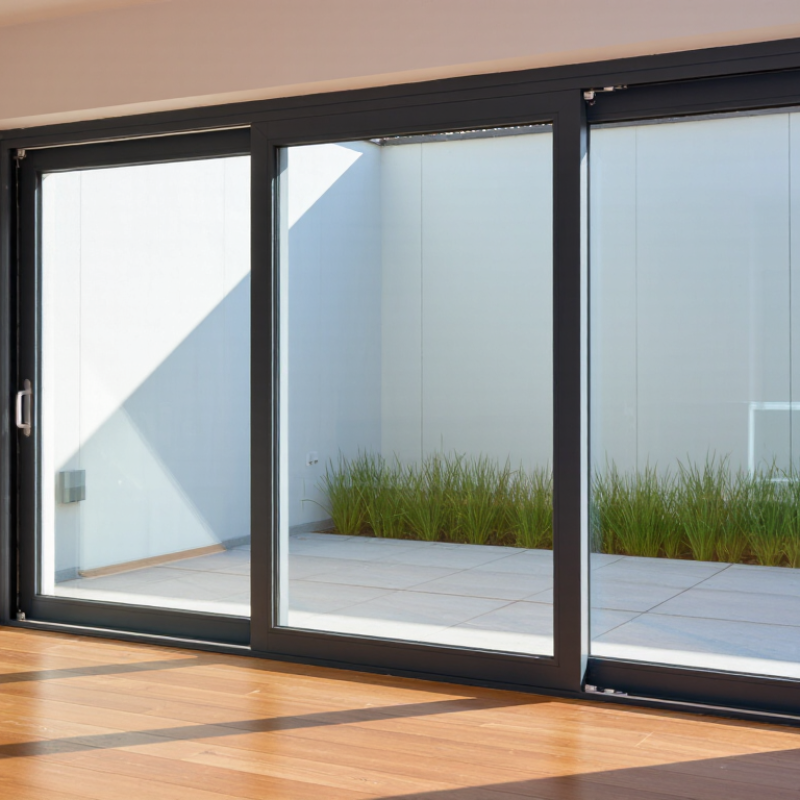
A three-panel sliding patio door usually combines one fixed panel with two sliding panels. This configuration creates a broad opening without requiring a large swing area. Some projects use one sliding panel and two fixed panels, but access becomes less flexible. The best choice depends on furniture layout, wind exposure, and daily traffic.
The opening mechanism starts with a reinforced head, sill, and low-friction roller system. Each sliding panel moves along its own track, then stacks behind the fixed panel or another moving panel. A lift-and-slide design can reduce operating resistance by briefly lifting the panel before movement. It feels smoother.
However, heavier glass increases frame load and installation sensitivity. Track alignment must remain precise, or the door may drag within months.
The U.S. Department of Energy reports that windows and doors can represent about 25% to 30% of residential heating and cooling energy use. Therefore, glazing, weather seals, and panel interlocks deserve equal attention. NFRC performance ratings help compare U-factor, solar heat gain coefficient, and visible transmittance. A lower U-factor generally supports better insulation, while solar control should match the local climate. Water drainage is another practical concern. A deep sill, weep paths, and correct flashing help manage driving rain. I have seen wide openings specified beautifully, yet installation details were treated as secondary. That remains a weakness worth correcting.
Performance Metrics: U-Factor, SHGC, Air Leakage, and Water Penetration
China Best 3 Panel Sliding Patio Door Manufacturer
Performance Metrics: U-Factor, SHGC, Air Leakage, and Water Penetration
Choosing a three-panel sliding patio door requires more than attractive sightlines. U-factor measures heat transfer through the door assembly. Lower values generally indicate better insulation. A well-insulated frame, sealed glass unit, and warm-edge spacer can improve winter comfort near the opening. Field inspections often find that poor installation weakens these gains.
SHGC shows how much solar heat enters through the glazing. A lower SHGC can reduce summer cooling demand, especially on south- or west-facing elevations. However, very low solar gain may reduce useful winter warmth in colder climates. Air leakage is commonly reported in cubic feet per minute per square foot at a specified pressure. Lower leakage supports comfort and energy performance. Numbers need context.
Water penetration testing examines resistance under controlled pressure and simulated rainfall. Proper sill drainage, corner sealing, and weep paths are essential. A door may pass laboratory testing but perform poorly when the sill is uneven. That is an uncomfortable lesson.
Tips: Request complete test reports, not isolated ratings. Confirm the test size and pressure. Check whether values apply to the full door assembly. Review installation instructions with the site contractor. Use compatible flashing and sealants. Inspect the track and drainage openings after installation. Small details matter.
China Best 3 Panel Sliding Patio Door Manufacturer - Performance Metrics: U-Factor, SHGC, Air Leakage, and Water Penetration
| Performance Metric |
Recommended High-Performance Benchmark |
Unit |
Relevant Test Method or Standard |
What the Result Indicates |
| U-Factor |
0.25–0.30 or lower |
Btu/h·ft²·°F |
NFRC 100; ISO 10077-1 or ISO 10077-2 for thermal transmittance calculations |
Lower values indicate better resistance to heat transfer through the complete door assembly, including the frame and glazing. |
| Solar Heat Gain Coefficient (SHGC) |
0.25–0.40, selected according to climate and orientation |
Dimensionless ratio |
NFRC 200; ISO 15099 |
Lower SHGC reduces unwanted solar heat gain; a higher value may be beneficial in heating-dominated climates or shaded elevations. |
| Air Leakage |
≤ 0.20; maximum commonly referenced threshold: ≤ 0.30 |
cfm/ft² at 1.57 psf |
NFRC 400; ASTM E283; AAMA/WDMA/CSA 101/I.S.2/A440 |
Lower air leakage means fewer drafts and lower uncontrolled heating or cooling losses around the sliding panels and seals. |
| Water Penetration Resistance |
No uncontrolled water penetration at the specified test pressure; 7.52 psf (approximately 360 Pa) is a common residential benchmark |
psf or Pa |
ASTM E331; AAMA/WDMA/CSA 101/I.S.2/A440 |
The assembly should prevent uncontrolled water entry when exposed to wind-driven rain at its rated test pressure. |
| Condensation Resistance Factor (CRF) |
Higher than the project minimum; compare complete-product ratings where available |
Dimensionless rating |
NFRC 500 |
A higher rating indicates better resistance to interior surface condensation under standardized laboratory conditions. |
| Design Pressure / Performance Grade |
Select a rating appropriate for local wind speed, building height, exposure, and opening size |
psf or performance grade |
AAMA/WDMA/CSA 101/I.S.2/A440; project-specific building-code requirements |
Confirms that the three-panel door has been evaluated for structural loads and weather performance appropriate to the installation location. |
Note: The benchmark values above are general technical reference ranges, not product-specific certifications. Final performance depends on the complete tested door size, glazing package, frame, hardware, installation method, and applicable local building requirements.
Materials and Glazing: Aluminum Profiles, Low-E Glass, and IGU Options
For a China-based 3-panel sliding patio door manufacturer, material selection begins with stable aluminum profiles. Aluminum resists moisture, insects, and dimensional movement. It also supports slim sightlines and large glass areas. The International Aluminium Institute reports that recycled aluminum requires about 5% of the energy used for primary aluminum production. That figure makes recycled content worth discussing, although certificates and actual alloy sources must be verified.
Glazing controls comfort more than appearance. The U.S. Department of Energy estimates that windows can account for 25% to 30% of residential heating and cooling energy use. Low-E glass helps limit infrared heat transfer while preserving daylight. In colder regions, a low solar-control coating may improve passive heat gain. In hotter regions, a spectrally selective coating can reduce unwanted solar heat. The wrong coating can still create glare or reduce winter warmth.
IGU options add another performance layer. A double IGU with an argon fill, warm-edge spacer, and Low-E coating usually offers better insulation than clear single glass. NFRC ratings help buyers compare U-factor and solar heat gain coefficient under consistent conditions. Three panels need careful alignment. Small installation errors can increase air leakage, even with good glass. That detail is easy to underestimate. A manufacturer should provide tested performance data, drainage design, hardware load limits, and compatible glazing thicknesses. Not every “energy-efficient” specification reflects a complete door system.
China Best 3 Panel Sliding Patio Door Manufacturer - Materials and Glazing Options
Typical thermal transmittance values for common aluminum profiles and glazing configurations. Lower U-values indicate better insulation performance. Actual results depend on profile design, spacer type, glass coating, cavity gas, door size, and installation quality.
Manufacturing Quality Control Under EN 14351-1 and ASTM E283 Standards
China Best 3 Panel Sliding Patio Door Manufacturer
Manufacturing Quality Control Under EN 14351-1 and ASTM E283 Standards
A reliable three-panel sliding patio door starts with controlled materials and repeatable testing. EN 14351-1 defines requirements for external pedestrian doorsets, including air permeability, watertightness, and wind resistance. Factory teams should verify frame dimensions, glass thickness, gasket compression, and hardware torque at every production stage.
Air leakage needs special attention. ASTM E283 measures air infiltration under controlled pressure differences, commonly at 75 Pa. Results are reported by airflow rate and specimen area. The U.S. Department of Energy estimates that windows can represent 25–30% of residential heating and cooling energy use. Small gaps around sliding panels can therefore create noticeable comfort losses.
Testing must reflect installation reality. Technicians should check panel alignment, roller adjustment, interlock engagement, and corner sealing before laboratory testing. Three-panel systems are sensitive to rail deflection. A door may pass production inspection yet perform poorly after transport. That weakness deserves review.
Quality records should include calibrated instruments, test pressure, specimen size, leakage readings, and corrective actions. EN 14351-1 documentation also requires consistent declared performance. ASTM E283 does not replace full product evaluation. It isolates air leakage.
Field experience shows that seals often fail from compression variation, not material defects. Human error remains possible. Continuous sampling, operator training, and independent verification improve reliability without hiding imperfect results.